Write the timeline before touching the machine
That last question matters. A machine can arrive with the original fault plus an incorrect part, disturbed connector, routing mistake or adjustment added during earlier repair attempts.
- What was the first symptom before any parts were changed?
- Did the failure begin suddenly, gradually or after a specific event?
- Which parts were installed, adjusted or disconnected, and in what order?
- Did any repair change the symptom, even briefly?
- Is the current complaint exactly the original one or a new one?
A parts box is not a test report
Commonly replaced components — carburetors, coils, sensors, batteries, belts and switches — can all be blamed by symptoms they did not create. Before condemning another one, confirm what the system asks of it and what it actually delivers.
Also verify the replacement itself. Correct mounting does not guarantee correct calibration, connector pinout, belt profile, spring rate, chain pitch or internal quality.
Separate the system into evidence
The missing or incorrect piece should be demonstrated under the conditions that create the complaint. That is a diagnosis. Everything before that is a theory.
- Inputs: sensors, switches, fuel supply, operator controls and power feeds
- Control: ignition modules, ECU commands, relays, carburetor circuits and safety logic
- Outputs: spark, injector pulse, actuator movement, clutch engagement and charging
- Mechanical reality: compression, timing, valve motion, alignment, structure and rotating drag
- Conditions: heat, vibration, load, terrain, deck height and chassis movement
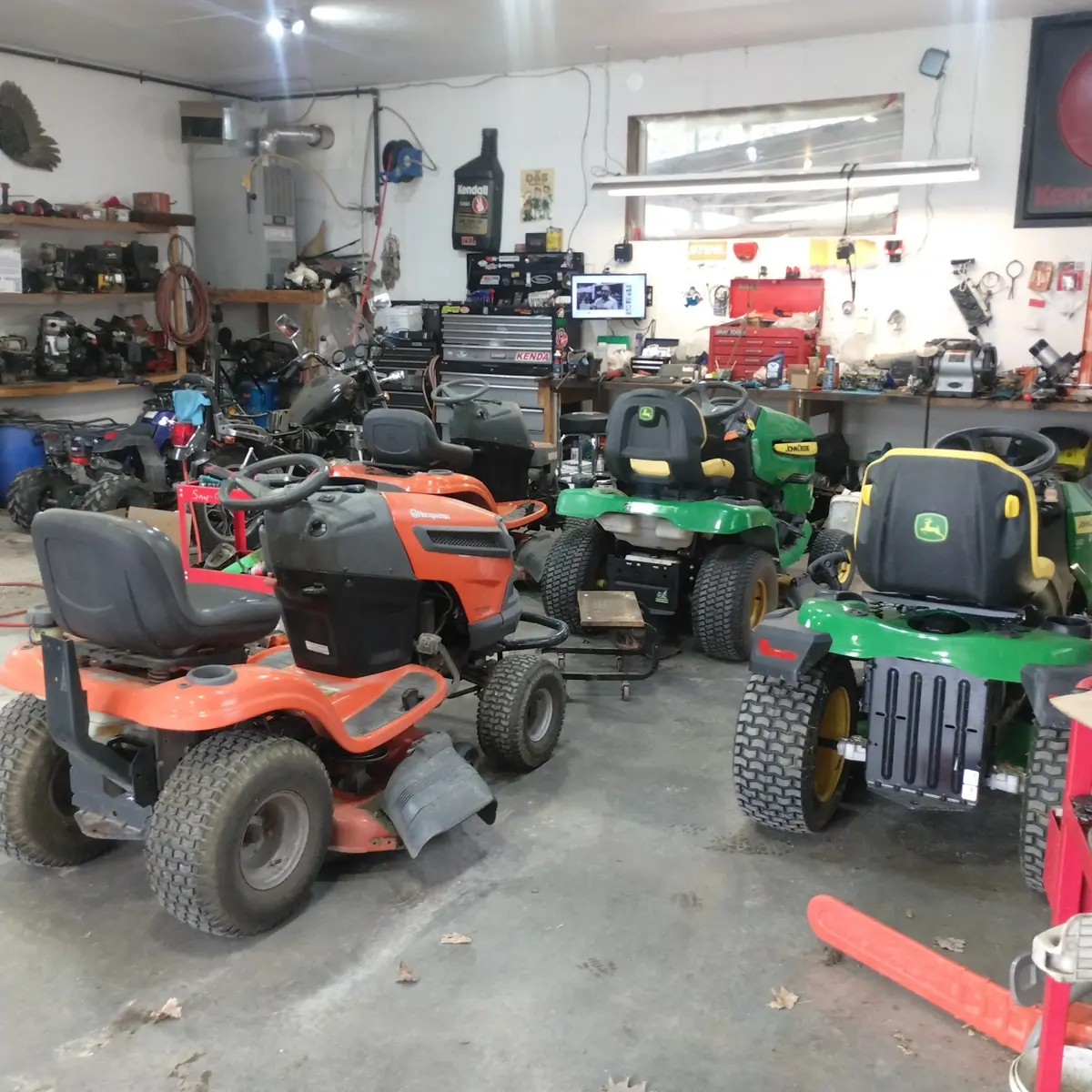
Real patterns from the D&S bench
- A fuel-looking mower problem came from water in fuel that was believed to be ethanol-free
- A deck kept losing its belt after noisy pulleys were addressed, shifting attention to lost tension under real load
- A broken ATV frame moved enough to break an intake-sensor wire, creating an electrical fault from a structural failure
- An intake backfire pointed toward valve motion and clearance instead of automatically condemning the carburetor
- A chainsaw locked after bar-and-chain work, making the reassembly sequence part of the evidence
The specialty is not guessing a rare failure. It is staying organized long enough to prove an unusual chain of events.
Bring the failed repair with you
Good previous work remains useful evidence. So does a theory that did not survive testing. The goal is not to assign blame; it is to get the machine's story straight.
- List every part and adjustment already attempted
- Include old parts when practical instead of throwing them away
- Bring model, serial and engine identification
- Send photos of wiring or disassembly before it was moved again
- Describe the exact conditions that reproduce the complaint
- Mention another shop's findings without treating them as either gospel or garbage
Know when the repair has become a safety issue
Stop using equipment with cracked structure, uncontrolled blades or augers, fuel leakage, overheated wiring, a binding chain, severe driveline vibration or defeated safety switches. A complicated diagnosis is never a reason to keep operating an unsafe machine.
The weirdest repairs become logical when every assumption can be challenged and every link from root cause to symptom has to be proven.
This is general information, not a diagnosis of your machine. Shut equipment down, remove the key, isolate the spark plug or battery as appropriate, let hot parts cool and keep fuel away from ignition sources. Stop if the check involves exposed moving parts, safety interlocks, internal timing or anything beyond your experience.